SPECIES DESCRIPTION
DIPLOTAXIS TENUIFOLIA
Family and Genus:- See- CRUCIFERAE
Common Names:- Perennial Wall-rocket.
Homotypic synonyms:- Brassica tenuifolia; Crucifera tenuifolia; Eruca
tenuifolia; Sinapis tenuifolia; Sisymbrium tenuifolium.
Meaning:- Diplotaxis (Gr) From diplous, “double”, and taxis, “row”, referring to the
seeds arranged in two rows in each locule.
Tenuifolia (L) “Slender-leaved”.
General description:- A perennial to subshrubby yellow-flowered crucifer with
deeply divided leaves and a strong rocket-like smell. Introduced and naturalised in
Great Britain.
Stems:-
1) Ascending to erect, branched, leafy and becoming somewhat woody at the base.
Leaves:-
1) Alternate, deeply pinnatifid to pinnatisect, with narrow lobes.
a) lower, petiolate.
b) upper, progressively shorter-petiolate or sessile.
Flowers:-
1) Inflorescence, an elongating raceme.
2) Sepals, 4, free.
3) Petals, 4, bright yellow, free and cross-shaped.
4) Stamens, 6, tetradynamous.
5) Ovary, superior, bicarpellate.
Fruit:-
1) Siliqua, linear, slender and borne on a distinct pedicel.
2) Seeds, arranged in two rows within each locule.
Distinguishing features:-
Distinguished by its perennial, often somewhat woody habit, narrow deeply divided
leaves, bright-yellow flowers and strong rocket scent.
Flowering time:- May to November.
Toxicity:- The leaves are cultivated commercially as wild rocket. Wild plants should
not be consumed without reliable identification and consideration of contamination
at urban or roadside sites.
Habitat:- Walls, railway land, waste ground, docks, road verges and other dry
disturbed places, especially in towns and near the coast.
Distribution:- The Balkans & Eastern Mediterranean: Native to Albania, Greece, the
western Balkans (up to North Macedonia), Bulgaria, Romania, and extending east
to Turkey, Syria, and the Black Sea region.
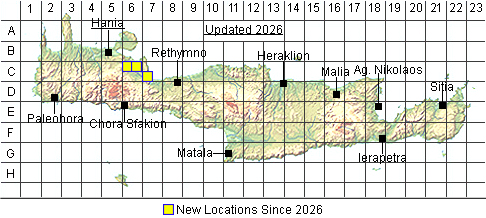
Previously unrecorded from Crete. First discovered by Christopher Cheiladakis on
15-04-2026 near Gavalochori then two further locations were found by Manolis
Petakakis Oct 26.
Conservation status:- None
Photos:- Courtesy Saxifraga - Free nature images & Christopher Cheiladakis